00:00
Create your account
Continue with GitHub, Google, or email when that provider is enabled for your deployment.
Release confidence + Playwright orchestration
Run your Playwright suites, organize executions by project and environment, inspect failures and history, and turn completed checks into a release-confidence signal.
Get from signup to your first test execution in about 5 minutes.
Keep Playwright and the CI/CD pipeline you already trust. ReleaseReady adds a focused execution, evidence, and release-context layer around them.
Checkout · Release 2.8.0
release/2.8.0 · staging
Release Confidence
94.0%
Example snapshot · 48 of 51 captured checks passed
Passed
48
Failed
1
Duration
2m 18s
Latest execution #184
Manual trigger · resolved commit a84c02e
@smokePassed@checkoutFailed@apiPassedIllustrative data shown in a product-faithful ReleaseReady view.
Built for teams that already use Playwright
Real product, real execution context
ReleaseReady keeps the result beside the project, environment, trigger, reference, test selection, logs, evidence, and history that produced it.
Projects
Keep repository configuration, test selection, and the latest execution together.
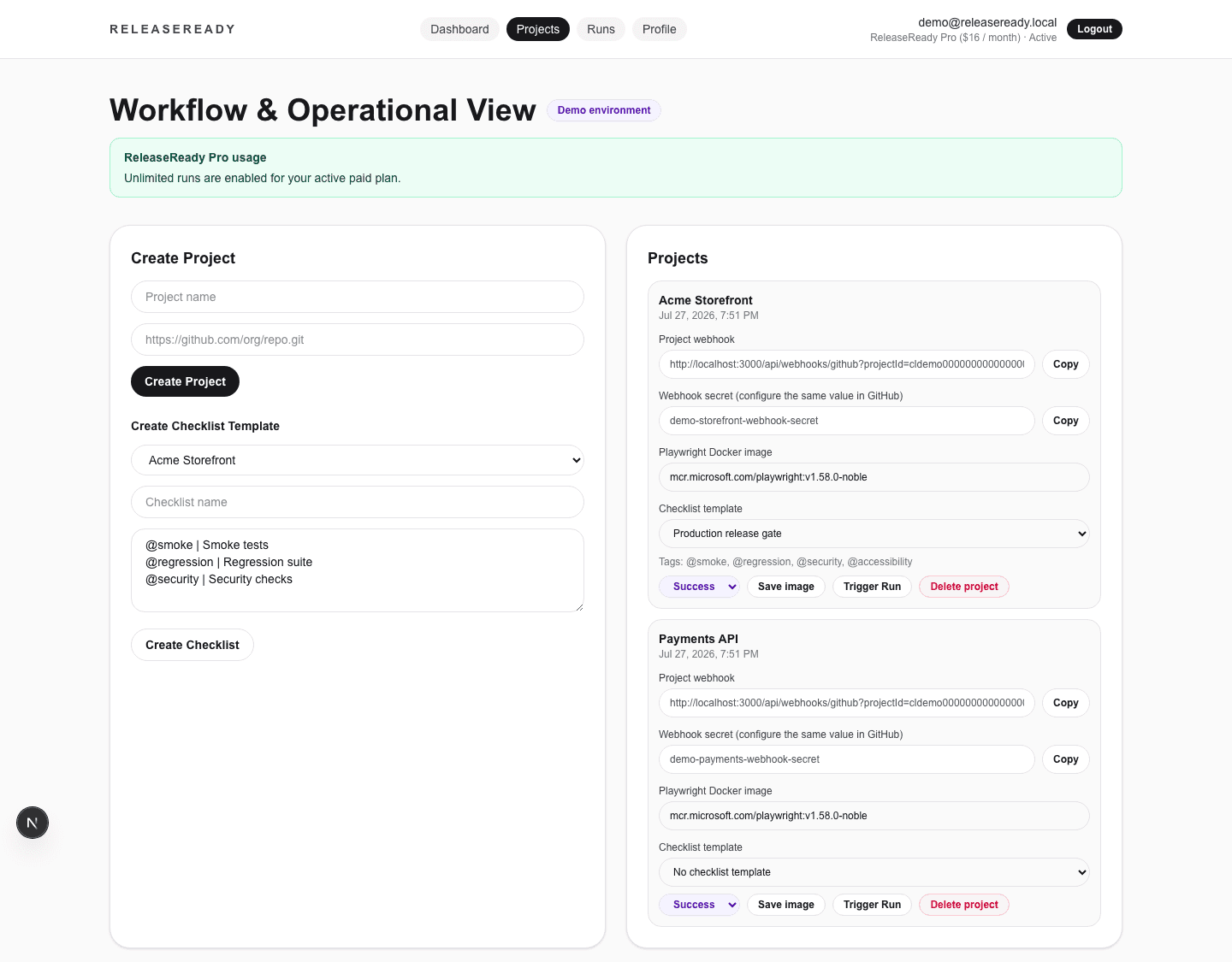
How ReleaseReady works
The workflow follows the release decision you are already making. Advanced controls stay out of the way until you need them.
Organize executions around the application, service, or product you are shipping.
Keep testing history and release context separated by project.
Store reusable variables and encrypted secrets for the environments your Playwright tests use.
Stop rebuilding runtime configuration before every execution.
Choose a repository, environment, checklist, or Playwright tags, then trigger manually or through GitHub.
Spend time on reliable tests instead of another execution layer.
Review status, failures, duration, branch and commit context, evidence, history, and release confidence.
Make release decisions with context—not a single green checkmark.
Your first run in 5 minutes
Start with one project, one environment, and the default all-tests selection. Add checklists, tags, webhooks, and richer release organization when they become useful.
About five minutes assumes you already have a compatible Playwright repository. Repository access and runner availability can affect setup time.
00:00
Continue with GitHub, Google, or email when that provider is enabled for your deployment.
00:30
A name is the only required field. Connect the repository next; advanced settings can wait.
01:30
Add only what your suite needs, such as BASE_URL, API_URL, ENVIRONMENT, or TEST_USER.
02:30
Use all tests by default, or select a checklist and Playwright tags for a focused run.
03:00
ReleaseReady records the request and keeps the status clear from queued through completion.
04:00–05:00
Inspect passed and failed tests, duration, logs, and source context. Add completed runs to a Release for a durable confidence snapshot.
From signup to your first execution signal in about 5 minutes.
Release Confidence becomes available when completed project runs are selected and captured in a Release.
Why teams use it
ReleaseReady turns the execution mechanism into a workflow your team can understand, revisit, and use to make a shipping decision.
See the state of your automated checks before a release moves forward.
Keep results, environment, project, branch, commit, and execution output together.
Retain the executions and evidence used for a release instead of losing context in old job logs.
Reuse Workspace environments and test selection across executions.
Use ReleaseReady as a focused Playwright orchestration layer around—not instead of—your pipeline.
Get useful orchestration and release visibility without adopting a heavyweight QA platform.
Playwright locally
Fast feedback for the person running the command.
Your CI/CD
Controls the wider build, deployment, and automation pipeline.
ReleaseReady
Coordinates Playwright runs and keeps the evidence in release context.
Product capabilities
Every capability below maps to a working ReleaseReady flow. Planned intelligence is labeled separately in the roadmap.
Trigger JavaScript and TypeScript Playwright repositories through direct or delegated runners.
Separate applications, members, environments, execution history, and release records.
Store visible variables and encrypted secrets, then capture an immutable configuration snapshot per run.
Define checklist templates and run only the Playwright tags relevant to the change.
Start manually, through the API, with a signed GitHub webhook, or from GitHub Actions.
Track queued, running, passed, failed, and cancelled outcomes with counts, logs, and downloadable evidence.
Preserve the requested reference, executed repository, resolved commit, and trigger source.
Select completed project runs, snapshot their evidence, and calculate Release Confidence from captured checks.
Product evolution
ReleaseReady is growing around the software release workflow. Current and future capabilities are deliberately separated.
Run tests without building another interface around your execution layer.
Understand what ran, where it ran, and which evidence supports the release.
In development: expanded runtime and stability rollups built from execution history.
Use deeper execution history to surface patterns and risk before production.
No AI prediction, recommendation engine, flaky-test score, or average-runtime rollup is presented as currently available.
Who it is for
Solo developer
“I have Playwright tests, but I do not want to maintain a separate execution dashboard.”
Use one focused layer for triggering runs and reviewing results.
QA engineer / SDET
“I need better visibility into environments, failures, tags, and execution evidence.”
Keep automation organized around the release decision.
SaaS team
“We need a clear testing signal before deploying a new version.”
Combine test execution with project, environment, and release context.
Small engineering team
“We need orchestration without an enterprise testing platform.”
Adopt a lightweight workflow that complements the tools you already use.
Simple monthly pricing
Use the free allowance to validate your workflow. Upgrade when you need unlimited runs and the full paginated execution history.
ReleaseReady Free Trial
$0 for 7 days
50 executions or 300 execution minutes, whichever comes first
ReleaseReady Pro
$16 / month
Billed monthly through Stripe
If a Pro trial is enabled for your deployment, its current duration appears in Stripe checkout before you subscribe.
Know what you are shipping
Get your first Playwright execution running in about five minutes—without replacing your CI/CD pipeline.